Pauline Jackson
The Darling Buds of MayPauline Jackson is a strawberry picker at Benacre whose brief encounters with Cedric Charlton and Mariette connect the labor of the harvest to the novel’s romantic and social tensions. Introduced at the picking tent during an exceptionally hot day, she becomes both an object of Charlton’s attention and Mariette’s opponent in a fight in the fields; her place in the story is inseparable from the seasonal work on which the Larkin household depends.
Identity and Introduction
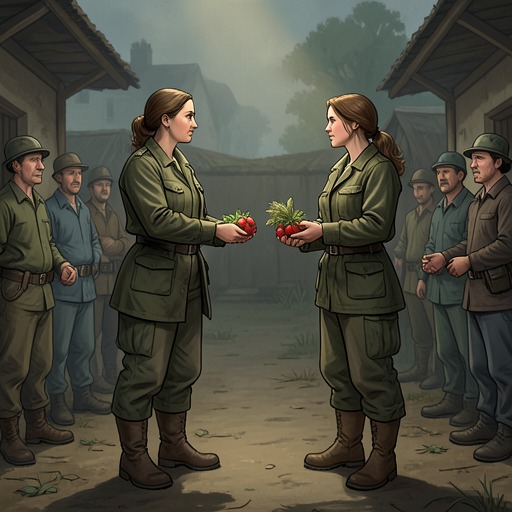
Pauline arrives at the tent to register a picking order, giving her name and specifying two dozen baskets. She is described as fair-haired, with blue eyes and deeply tanned skin from working outdoors; her hair is tied back in a long ponytail. The scene establishes her as a worker in the harvest rather than a visitor to it: she comes to the tent with a practical purpose, and Charlton is there to record the pickers’ produce.
The encounter quickly becomes personal. Pauline takes a strawberry from a basket, bites into it, and asks Charlton whether he likes strawberries. When he answers that the Larkin family call him Charley, she is already drawing him into the informal familiarity of the farm. The exchange makes the fruit itself part of their introduction: a sample from the crop is both the subject of Charlton’s work and the means by which Pauline addresses him.
Work in the Strawberry Season
Pauline’s appearance at the tent belongs to a harvest organized by the calendar. The Larkin truck passes fields prepared with straw, and Pop explains that strawberries will soon be ready. Picking is followed by cherries, then later-season crops including apples, plums, pears, hops, and potatoes; at strawberries alone, a large family could earn fifteen pounds a day. Montgomery reports that picking at Benacre will begin on Monday, earlier than usual after the warm weather. Pauline is one of the field workers within this larger cycle of seasonal labor and income.
Charlton’s first day in the fields gives the work a physical setting: late May is already intensely hot, with the previous day reported as the hottest May 30 in forty years and the new day expected to be hotter. As the temperature rises, many women remove their outer shirts and blouses to work in lighter clothing. Pauline later enters the tent dressed for the heat like the other pickers. Her presence there keeps Charlton’s attention divided between the practical business of weighing and recording fruit and the people who bring it in.
The scale of the harvest becomes visible through Charlton’s work. He calculates that more than a ton of strawberries has passed through the tent in a single day and reasons that this represents substantial earnings for the pickers. The number gives the strawberry season an economic dimension beyond the Larkins’ household: the tent is a point where a large volume of produce, labor, and potential income converges. Pauline’s baskets belong to that busy system, even as her exchanges with Charlton make the work setting intimate and socially charged.
Encounters with Charlton and Mariette
Charlton is initially captivated by Pauline. When she takes the berry from the basket, he fumbles with his book and papers as he answers her; later, after the heat has changed the working conditions in the field, he sees her again at the tent. The narration notes his response to her appearance, but the evidence does not establish a relationship between them. Their encounters remain brief, rooted in the workday and in Pauline’s teasing, direct manner.
The atmosphere changes when Mariette enters the tent carrying baskets. Pauline calls attention to the presence of company and looks at Mariette; the two women answer one another with visible hostility. Charlton, positioned between them in the tent, registers the contrast and the tension before it erupts outside. The scene turns a routine exchange of produce into a confrontation whose stakes are personal as well as social.
A sudden commotion draws Pauline, Mariette, and Charlton into the field. Pauline and Mariette are fighting, while other workers gather around them and shout. Charlton follows the others toward the scene, then stops when he recognizes the two women. The apparent blood on them is strawberry juice, smeared during the struggle. The fruit that has organized the day’s labor has become part of the conflict itself, staining the participants and collapsing the boundary between the work of picking and the emotions that have gathered around it.
Narrative Role and Significance
Pauline’s role is sharply defined by a small number of consequential scenes. She enters as a worker bringing an order to the tent, becomes a focus of Charlton’s attention, and then confronts Mariette in the field. The sequence gives her a distinct presence without supplying a broader biography or a later account of her life; the evidence does not establish what becomes of her after the fight.
Her scenes also expose the precarious balance within the strawberry harvest. The season brings a great quantity of fruit and meaningful earnings, yet Pop warns that disease is finishing familiar varieties and that strawberries may soon disappear across the district. Against this threatened future, Pauline’s work and the day’s tonnage show the harvest at full intensity. Her conflict with Mariette punctures the smooth rhythm of production, while its setting among the pickers makes personal rivalry part of the same crowded world as labor, heat, and seasonal change.